Nubian Village – Aswan 033
Next morning we move towards a Nubian Village near Aswan. The collecting taxis are already on the way as well. These are pickups, which have built up in the back a cab and cover the local transportation. Most are open at the back, up to 12 people are transported on the truck bed. Would you like to get off you stamp your foot or knock on the window of the cab, then it stops.
In some places there are also three-wheeled bubble cars that are operated as taxis, but only find use in urban areas.
The journey is varied and leads through villages or directly along the Nile. Since the road is good, one must not focus so much on the road and we see several interesting things on the roadside.
Here, as throughout the whole Arab world, transports are quite unusual. Cattle are transported on the pickup, a strange sight.
After only a few driving hours and wonderful views of the Nile, we are approaching the city of Aswan. We plan to go on the other side of the Nile to a camp.
Shortly before reaching Aswan we cross the Nile on a fairly new bridge to Adams Camp.
Adams Camp no longer exists, but we find a very nice alternative at a Nubian Guesthouse of a Captain called Ashraf.
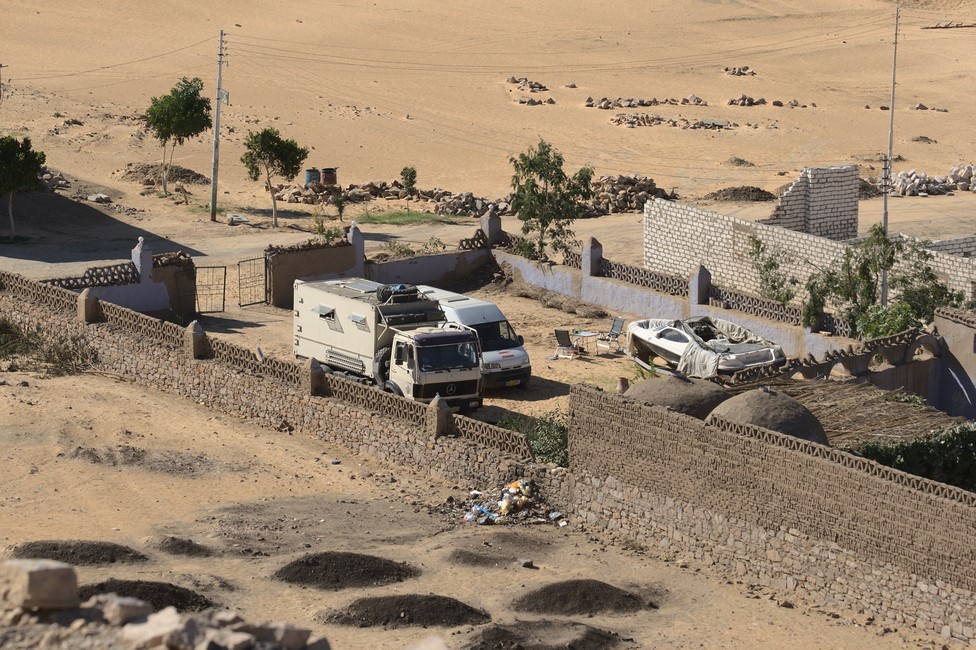
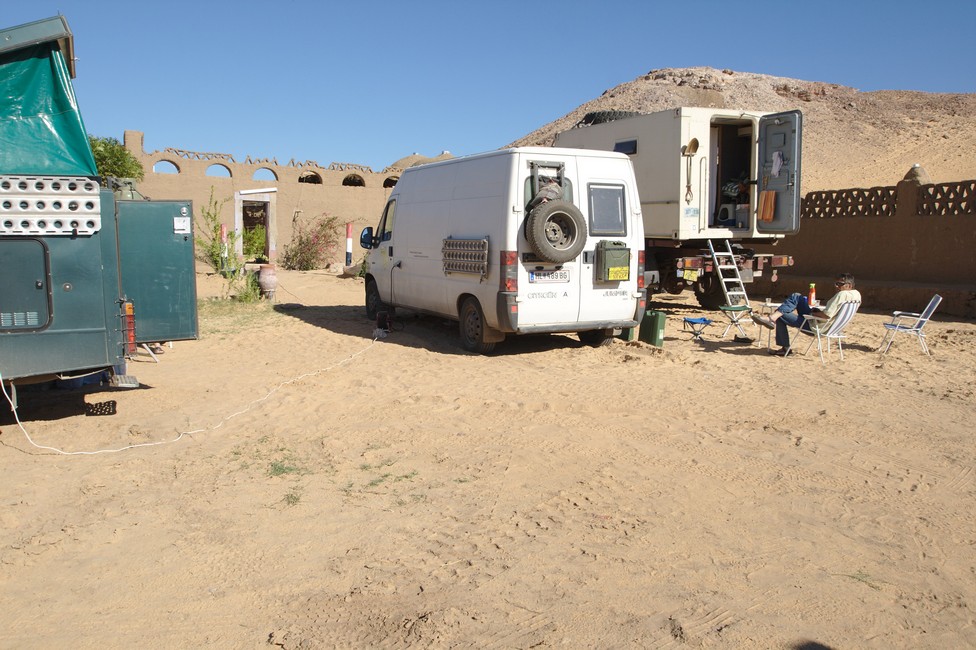
In the courtyard of his house, we can find accommodation, there are already a dutch couple who we had met in Cairo for the first time.
The location of the camp is great, on the edge of a Nubian village in the middle of the desert.
Ashraf also rents rooms in Nubian style. They are rooms in traditional mud houses. You will sleep on carpets on the dirt floor, as still practiced by the Nubians today.
Special luxury is a ceiling fan, which reduces the heat, if there is electricity, which here is far from normal.
The rooms lead directly into the courtyard, meals you have outdoors under a thatched canopy.
Toilets and bathroom are across the court in an extra building, theoretically there is also hot water if there is electricity. The rule should be that we draw water from a provided barrel.
Next day we climb up the nearby hill and enjoy the panoramic views of the Nubian village and the slowly flowing Nile.
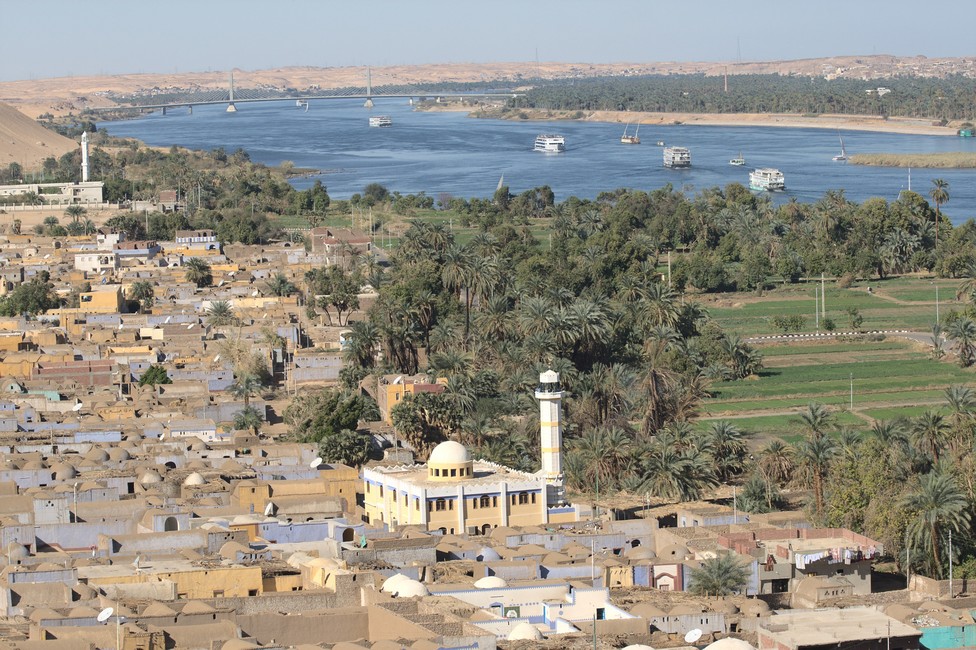
About Nubian architecture we know very little abroad. The traditional houses are made from mud brick. In Nubia the roofs are often dome-shaped or arched. Further south they are mostly flat. They are plastered or painted and beautifully decorated. Nubians have their own marriage traditions, the celebration will take up to 15 days. On the first night the bride and groom celebrate separately with friends and family. The second night the bride moves her party into the house of the groom and all are dancing until the morning. Then the bride goes back into the family home. Her hands and feet are painted with henna. Even hands and feet of the groom are decorated with henna. On the third day the groom takes his guests in a procession to the house of the bride. The whole day is sung and danced. The bridegroom is three days in the house of the bride. Then the couple is building an own house.
The settlement area of the Nubian extends from southern Egypt into northern Sudan, and was a homogeneous area of settlement. The Nubians were originally Christians. In the 12th and 13th century the attacks Egypt against Nubia increased. 1315 the last Christian king of Nubia has been replaced by a Muslim and a majority of the population converted to Islam. When the Sudan was in 1899 English condominium, a border was drawn between Egypt and the Sudan, 40 km north of Wadi Halfa and Nubia so was divided, thus many Egyptian Nubians have relatives in Sudan, as well as our friend Ashraf.
The Nile has always determined the fate of the Nubians. When the Aswan Dam was completed in 1902, and increased in 1912 and 1934, the water of the Nile rose slowly from 87 meters to 121 meters. However, many buildings were flooded. In the 1930s many Nubian villages disappeared under the water masses. Many homeless Nubians moved to Egypt, where they bought land and built new villages. Most Nubians assumed that the flow patterns would not change and remained at their original homes and rebuilt their houses on new land slightly higher.
But the water level rose again. Date plantations, the main income of the Nubians, were destroyed. Many Nubians were forced to seek work in the north and left their families. Less than 30 years later the building of the new High Dam forced people to move again.