Chott El Djerid overland and Problems with the Camper Van 009
We leave Tozeur to go to chott el djerid overland and a short time later, again our car just stops. Although somewhat annoyed we still enjoy the beautiful landscape of dry river valleys and interesting surveys. We hope that the car starts again, maybe it’s just become too hot, we are somewhat perplexed.
Heidi and Guido catch up. We advise on the car´s problems and they decide to stay with us in case of the worst-case scenario. Before we proceed we have delicious dates, which we bought in Tozeur.
Dates grow only in oasis gardens with elaborate irrigation. Here at Tozeur they harvest high quality. Only the best is exported.
In desert regions the dates are one of the most important basic foods. They are nutritious and are rich in vitamins and can be stored for long periods, and additionally taste delicious.
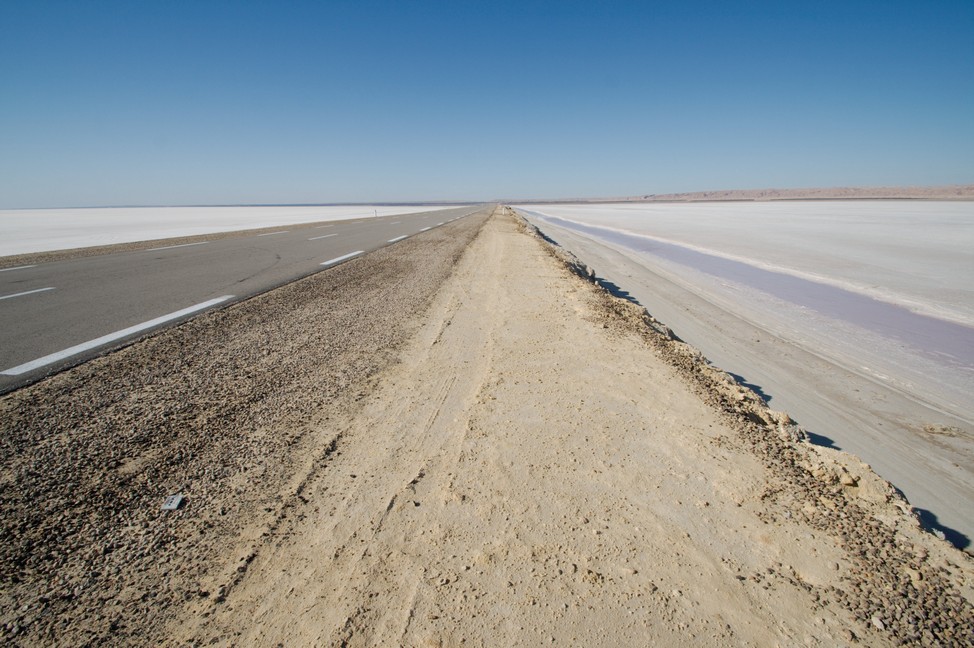
We drive on through the Chott el Djerid overland, the largest contiguous salt desert of the Sahara. This region has little precipitation, evaporation is 25 times higher than the rainfall. Streams from the mountains, enriched with dissolved salts and gypsum fill this sink. In the border zone after the rains often several meter deep salt marshes are formed. With increasing heat the salts crystallize and form a thick crust.
The Sahara is the largest desert in the world. It is about as large as the whole United States of America. It stretches from the African Atlantic Coast beginning at Maroc up to Egypt. The Sahara is mainly stone desert. The percentage of sand is only 20 Percent. Temperatures range from up to 60 Degrees Centigrades during noon to minus 10 degrees during night. It is raining here as well, but only very seldom, some years not at all. It is inhabited by Arabs, Berber and Mauren. There are also small groups like the Tuaregs. 60% of the population is living in oasis, 40% are nomads or semi-nomads.
Below the crust the soil often remains muddy for long, which makes driving on it an uncertain adventure. Even in the 1970s, only one mud road lead through the Chott, because of the lack of maintenance again and again it was interrupted, and often was completely impassable. Since the completion of the asphalt road it is open year-round. For more than 40 km the road leads through the Chott and has lost its terrors for desert travellers.
A lot of stories rank around the Chott el Djerid. Writers of 14th century report that a caravan of 1,000 camels had disappeared in the Chott without trace, Karl May also reported on the dangers of the Chott.
In Kebili we come to a halt. Our motorhome doesn’t move any more. Not a single metre. We have to go to a workshop. The tour guide Joachim and Renate have already arrived at the scene.
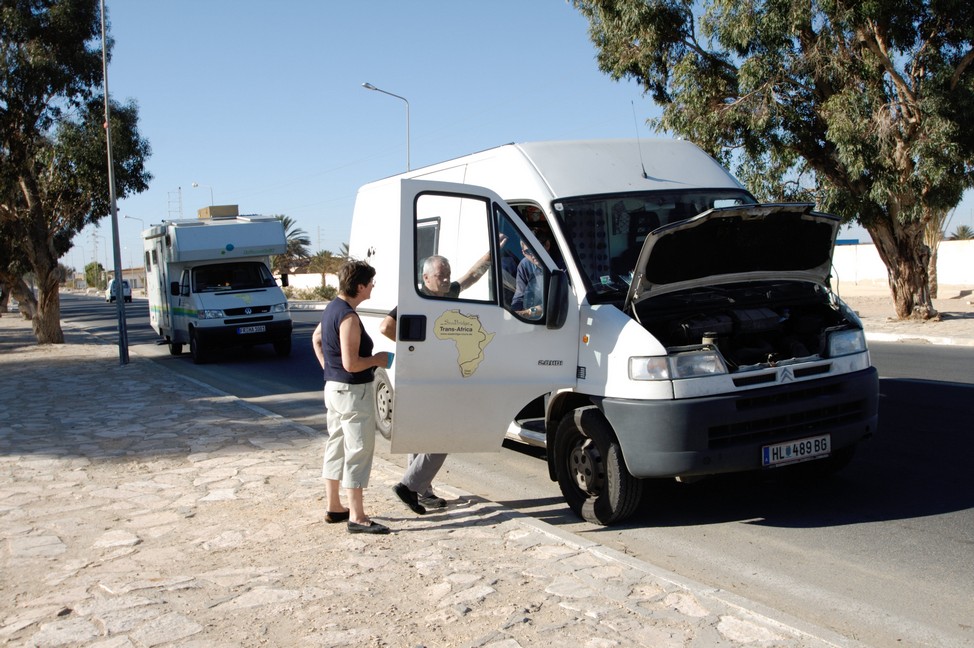
Many heads – many opinions. What is the problem, no one really knows. Large helplessness sets in, but also many theories to come. The most persistent is taken. We could have tanked bad diesel that was stretched out with water and therefore the whole system has to be cleaned. The tank must be emptied and washed out, the pipes must be cleaned, also allegedly a false diesel filter is installed. That makes me sceptical, but hope dies last. I look more closely at the workshop. On the ground is being broken down an engine. It belongs to a Peugeot 404, probably built in 1965. Are they able to cope with the modern Citroen?
It is becoming clear that they have not found the error and Joachim and Renate tow us to the campsite at Douz; where there is said to be a good mechanic who would fix the problem soon.