Tozeur a medievial city 008
We turn off to the centre of Tozeur, the streets are narrow, the traffic heavy and we need a fairly large parking lot for our vehicles.
The city makes a very nice impression. We wind our way through the main street with restaurants, cafes and many shops. Woven carpets dominate the streets. Finally, we find a parking space in front of a bank.
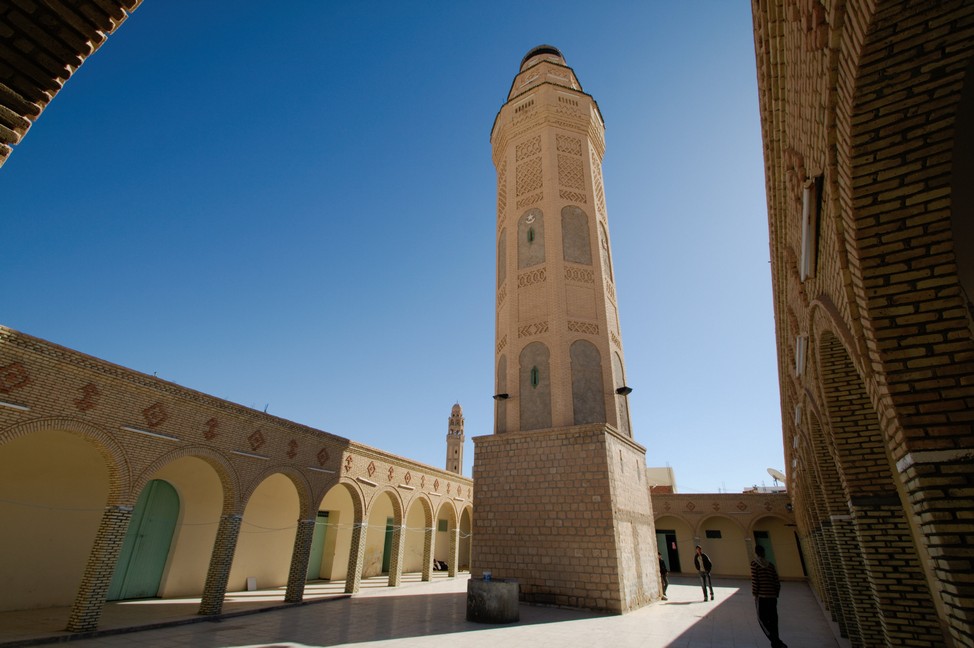
We are fascinated by the old, slender minaret that overlooks the Old City. We feel as if we are in the world of Lawrence of Arabia or transferred into the tales of 1001 nights. On the main road there are shops one after the other – hidden under arcades to protect from the blazing sun. Here it can reach well over 50 degrees in summer. Here the horse cart is not a tourist attraction but is everyday transport.
Elaborately decorated is the central fountain. On multi-story cylinders tiles are fixed, the well is built of mud bricks, which are strung together in a pattern. The fountain is a central meeting place for the people of Tozeur. Woven carpets determine the city. In all colours and patterns they are offered. Tunisia is famous for its carpets. This craft is one of the oldest of the country. They are produced within the craftsmens home, the chief merit is not with the weavers. There are woven and knotted carpets. An important factor of quality is the number of knots per square meter. Here dominates the so-called Mergoum, a very solid woven carpet. Also the kilim is common here. It is a woven rug or wall hanging with geometric or figural motifs, which are predominantly Berber origin. Luck symbols such as fish, eyes, but also landscapes are the motives.
Famous is the mud brick architecture in Tozeur. Layed in different scheme the ocher mud bricks form interesting geometric ornamentation. The style goes back to the 10th century, which was brought here by Arab immigrants from Mesopotamia. A quick look at the city map of the travel guide and we find a cafe to stop at. We sit together with Heidi and Guido at the cafe on the roadside and watch the interesting life passing by.
Although Tunesia is said to be safe, we like to have our camper van in view.
One Comment