Kairouan to Sbeitla – overland travel 007
Before we head to Sbeitla we spend the day in the courtyard of the hostel of Kairouan.
The next morning at dawn we break up again. The route runs from Kairouan to Sbeitla and to Tozeur, and from there through Chott El Jerid further on to Douz. At dawn we leave the city. We can not find the correct exit road, we are still doing the lap of honour along the walls surrounding the historic centre. The traffic at this time in the otherwise very busy city is fairly quiet, inspite of that one must be careful, because here everybody goes back and forth and the pedestrians are often unpredictable. Otherwise, driving is no problem, we drive on the same side as most countries in Europe, this will change once reaching Kenya.
Kairouan we liked very well, a shame that we had just one day, there is still so much to be seen. We have a satellite navigation device on board with a map of a South African producer. The Tracks4Africa are a good help when navigating, although Tunisia still has some white spots in the map.
Finally, we have circled the city and are on the right road to Sbeitla. We enjoy the journey overland, for there are so many interesting things to see.
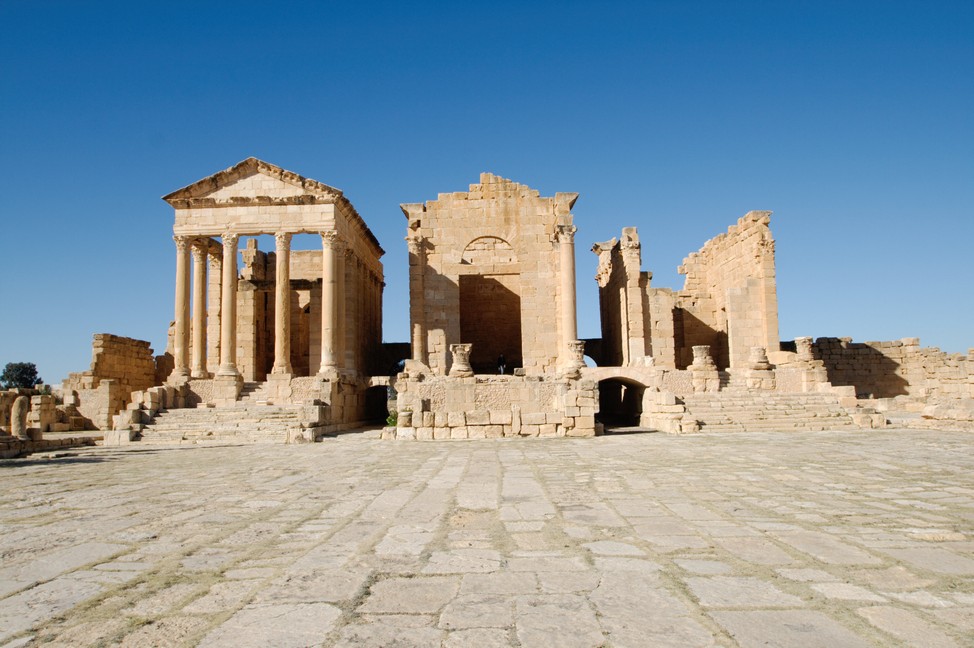
After a short drive we reach Sbeitla where the Roman excavations Sufetula are. Even from outside the excavation site, you can visit the Arch of Diocletian. Overrestored, we feel the theatre, with its charming location. But impressive is the archway that leads to the Forum and Capitol. The three arches Antoninus Pius Arch borders the 70 meters long and 60 meters wide forum. Particularly well preserved is the three-part Capitol temple, dedicated to the Roman gods Juno, Jupiter and Minerva. Especially beautiful is the front and the Corinthian columns at the temple of Juno.
Continuing on we pass through Kasserine. The city lies between two mountain ranges and is a French foundation. The main street runs five kilometers through the village. Here exists denser traffic, and we progress slowly. In Kasserine, we left the ridge of the Dorsale behind us, which is a climate barrier and prevents the humid Mediterranean air masses from the central Tunisian savannah. It is hot and dry here. South of Gafsa begins the desert savannah and the Sahara. The road condition is good in Tunisia, the further you get into the South and in the hotter climate zones, the worse the asphalt gets, because it softens by the heat.
Since the last gas station our car has problems. It turns off the engine by itself. We stop at the roadside and replace the diesel filter. Then there is peace and it goes on. We arrive easily without problems to Gafsa and want to visit the Casbah.
From the building only the outer walls, some side buildings and three corner towers have survived. In the second World War, the French hold a munitions depot here, which flew into the air and damaged the Casbah.
From Gafsa, we head towards Tozeur. Guido and Heidi have overtaken us and we want to visit Tozeur and have coffee together.